
Rapax 2.0 has been generally available since October 10. It is the biggest change we have made to the platform, and it was a deliberate bet. This post explains why we made it, and what it means for our customers, our partners and the industry we work in.
Why we invested in the change
I have spent 25 years building service assurance platforms. I founded Assure1, sold it to Oracle in 2021, and then watched customers run what we had built. The lesson that stayed with me had nothing to do with features.
Organizations bought capable tools, then found the tools needed people they didn’t have: engineers who understand polling, thresholds, correlation rules, upgrades and the hundred small decisions that keep monitoring trustworthy. The license was the cheapest part of the purchase. The expertise to run it was the expensive part, and usually the missing part.
That gap is getting wider. In EMA’s 2026 research, 52% of network teams said they struggle to hire and keep network engineers, up from 26% in 2022, and only 31% called their network operations strategy completely successful (EMA Network Management Megatrends 2026).
Rapax 1.x was built the way assurance platforms have always been built: for operators with a team behind every install. It works for them. A mid-market fiber ISP serving more than 600,000 subscribers deployed it against its existing Kafka streams, and the initial deployment took under two hours. But the conversations we kept having with everyone else ended the same way. The platform made sense, and they had nobody to run it.
So for 2.0 we had a choice. We could add features for teams that already have a platform team, or take the operating cost out for everyone who doesn’t. We chose the second, and every decision in the release answers one question: does this make Rapax easier to run?
What changed in Rapax 2.0
Rapax 2.0 got wider and simpler at the same time.
Wider. One platform and one data model now cover the real-time operations job:
- Log collection, plus ping and SNMP v2c/v3 polling, with no device agents
- Correlation and root cause, with every alert mapped to the services and customers it affects
- Baselines, anomaly detection and capacity forecasts that arrive as a date
- Native ticketing, a customer portal, availability and SLA reporting
- Configuration history, a knowledge base and multi-tenant views per customer
Simpler. One script installs it. Updates take one click, with a snapshot first and rollback if anything fails. Backups, certificates, components and remote collectors are managed from the browser, and a Get Started guide checks each setup step. Our design target is that one NOC manager runs the tools in a couple of hours a week. That is a target, not a measurement, and the evaluation is where you can hold us to it.
Agents that do the paperwork. Six AI agents do the watching, sorting and paperwork. Oscar briefs, Nora builds inventory from your descriptions and network drawings, Wade answers from your runbooks with the source cited, FRANK handles tier-1 support, Grace sends notifications you can answer by email, and Bruce builds integrations from vendor documents. They use the AI provider you choose, including Ollama on your own network, and changes to your network or configuration wait for a person to confirm them.
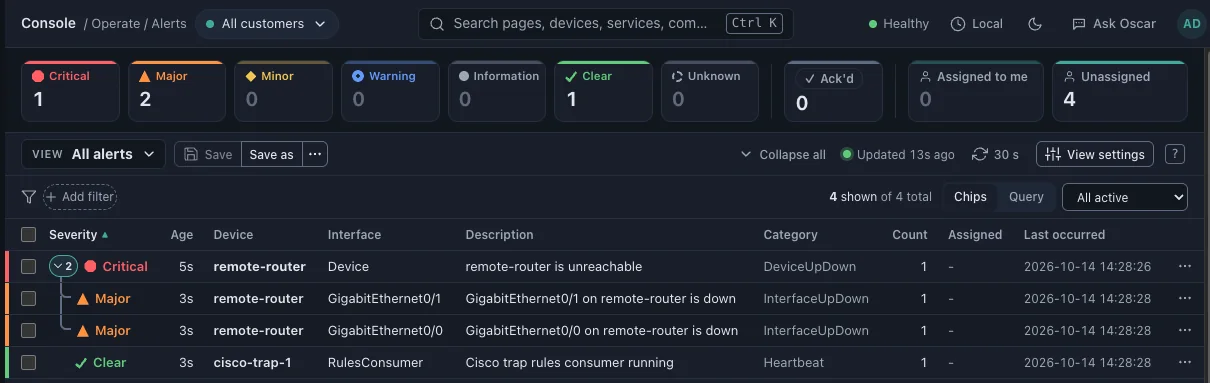
Rapax 2.0 passed all 46 of its test suites at general availability: 4,475 checks, zero failures. We call the result NOC-in-a-Box: everything real-time operations needs, hosted for you, with the agents and setup help to put it to work. Your team still makes the calls.
What it means for our customers
- IT operations teams get the coverage of several tools with the administration of one. The hours that went to upgrades, certificates and broken integrations go back to the network. Rapax for IT operations
- Service providers keep the depth we built for operators, from a fiber cut correlated to the subscribers on it to monitoring built from your as-built drawings, without needing a platform team to run it. Rapax for service providers
- Existing Rapax customers should know that 2.0 is a new installation rather than an in-place upgrade from 1.x, and 1.x remains maintained. We will plan the timing with you.
Getting started looks different too. You request a free 14-day evaluation, and within two business days you get a login to your own Rapax system, hosted on a dedicated server in the United States, Canada, Mexico or Europe. If you keep it, converting is a license install and everything you built stays. If you don’t, you walk away and owe nothing.
What it means for our partners
The motion that has worked best for us is partnership. Wavelo resells Rapax alongside its OSS/BSS platform, and we co-sell with other partners on active opportunities. Rapax 2.0 makes that model easier to run.
- An evaluation takes days rather than quarters, so it fits inside a sales cycle instead of becoming one.
- Hosting and guided setup mean delivery is not a services drag on your team.
- MSPs can run NOC-as-a-service under their own brand: every customer gets a locked view, their own branding and reports, and a support portal where FRANK answers first.
If you already sell to IT teams, MSP customers or regional operators, our partner page explains the three ways to work with us.
What it means for the industry
Most assurance platforms in service today were designed for the largest operators. They assume a dedicated team behind every install: installation is a project, upgrades are events, administration lives at the command line and root cause needs a specialist. Those assumptions fail a 40-person IT department, or an MSP watching 30 customers with five engineers.
The market is ready to move. In the same EMA research, 73% of organizations said they are at least somewhat likely to replace a monitoring tool within two years, and 55% now treat AI features as a requirement (TechTarget on EMA 2026).
AI on its own is not the answer. Gartner finds that only 28% of AI use cases in infrastructure and operations fully pay off, and that success comes from building AI into existing workflows (Gartner, April 2026). That is the bar we set for Rapax: AI inside the console, the ticket and the knowledge base, answering from your own documents, with a person confirming every change.
What changed is that capabilities once built only for carriers can now run on one server, for a network of a few hundred devices. The question is no longer whether you can afford assurance. It is whether your assurance can run without a team you can’t hire.
Read the paper, then try it on your own network
The NOC-in-a-Box position paper sets out the full argument: what running monitoring really costs, with every assumption shown, the six-point test for modern assurance, and exactly what changed in 2.0. If you would rather watch first, there are eleven short videos, recorded on real Rapax 2.0 screens.
Then see it on your own devices. The evaluation is free for 14 days, and the request form never asks for passwords or API keys.
Shawn Ennis is the founder of Rapax. He has spent 25 years building network service assurance platforms, holds 12 patents in network management and service assurance, and founded Assure1, acquired by Oracle in 2021.